Author: Lucas
-
Evaluating Graphical Perception in Virtual Reality: Evidence from Two Visualization Experiments
Accepted at Graphics Interface 2026 Abstract: Although Virtual Reality (VR) is increasingly used for information work, there is a limited understanding of how data should be encoded in immersive visualizations to support accurate interpretation. It remains unclear whether established two-dimensional graphical perception guidelines generalize to VR settings with different viewing conditions. To address this gap,…
-
Redesigning Large Language Model Coding Assistants for Software Engineering Education
Presented at Mensch und Computer 2025 Abstract: Large Language Model (LLM) coding assistants have become ubiquitous in software development environments, and features such as auto-completion and contextual code suggestions are now easily accessible to software engineering students. While these tools benefit productivity improvements for experienced developers, their presence in programming education potentially creates major challenges…
-
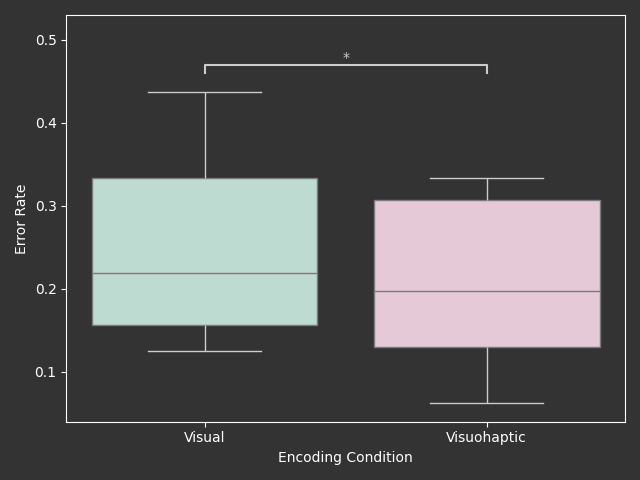
Assessing Sensory Modality Conditions on Retention of Tomographic Images
This analysis explored how encoding modalities (Visual and Visuohaptic) influence user performance in a delayed match-to-sample task involving tomographic slice excepts. The focus was on comparing error rates and response times between the two conditions to assess the effects of multisensory integration on task efficiency. Data Cleaning and Preprocessing Participants with overall performance below 60%…
-
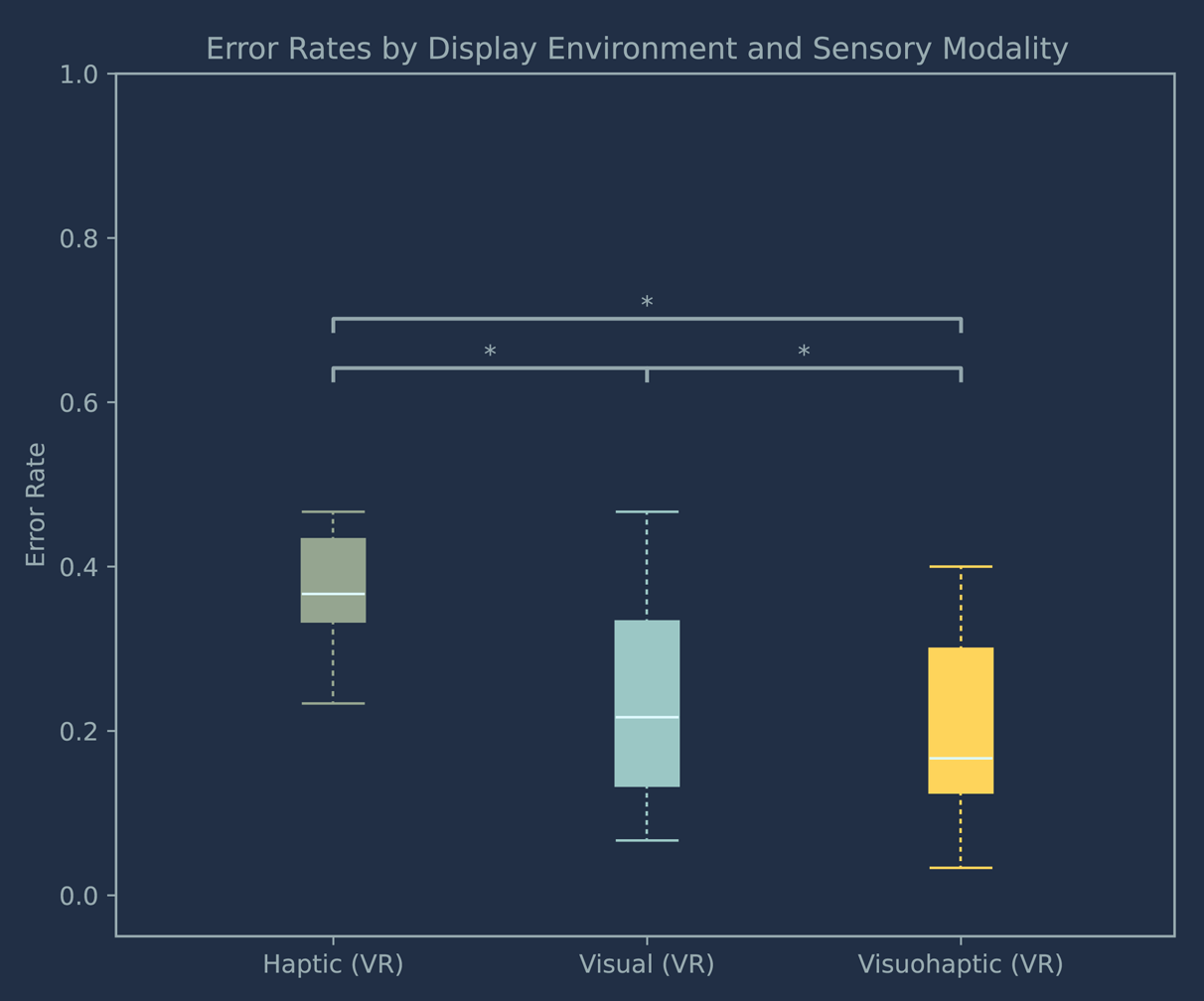
Statistical Analysis of Visuohaptic Integration Effects on Memory Performance in Virtual Reality
This project investigated how sensory modalities (Visual, Haptic, Visuohaptic) influence user performance in a Virtual Reality (VR) environment. Key metrics analyzed included error rates and response times across conditions, providing insights into how sensory feedback impacts task performance. Data Cleaning and Preprocessing Participants with overall performance below 60% (fewer than 54 correct responses out of…
-
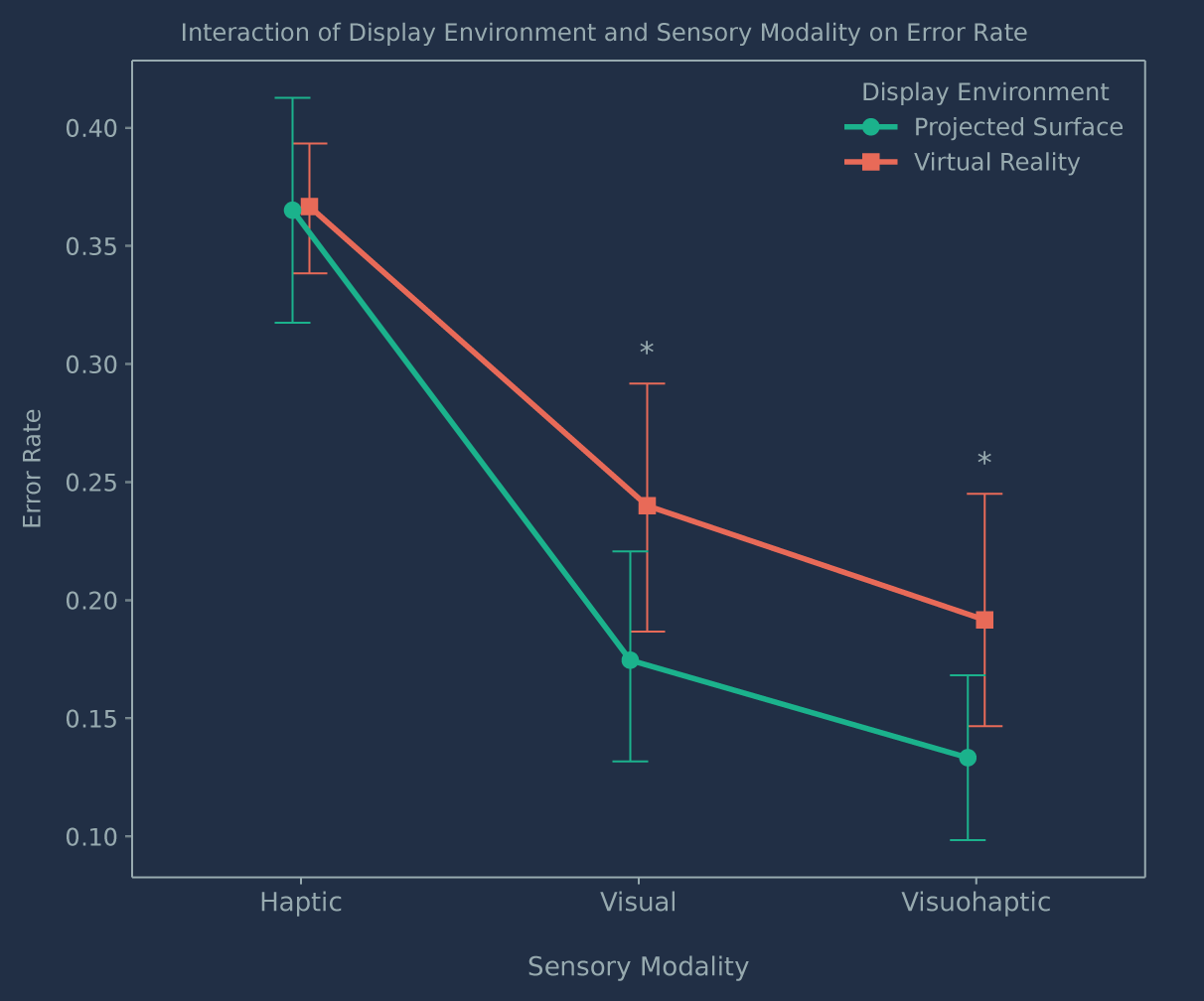
Analyzing Performance Metrics Across Sensory Modalities and Display Environments
In this project, I explored how display environments (Virtual Reality vs. Projected Surface) and sensory modalities (Visual, Haptic, Visuohaptic) influence user performance in terms of error rates and response times. Using advanced statistical tools, I processed and interpreted the data to uncover actionable insights into human-computer interaction. Data Cleaning and Preprocessing Ensure data quality by…
-
Assessing the Effects of Sensory Modality Conditions on Object Retention across Virtual Reality and Projected Surface Display Environments
Presented at Interactive Surfaces and Spaces, Vancouver (ISS 2024) and published at the Proceedings of the ACM on Human-Computer Interaction Abstract: Haptic feedback reportedly enhances human interaction with 3D data, particularly improving the retention of mental representations of digital objects in immersive settings. However, the effectiveness of visuohaptic integration in promoting object retention across different…
-
MorphoHaptics: An Open-Source Tool for Visuohaptic Exploration of Morphological Image Datasets
Accepted at the 21st International Conference on Culture and Computer Science (ACM KUI) Abstract: Although digital methods have significantly advanced morphology, practitioners are still challenged to understand and process tomographic data of specimens. As automated processing of fossil data is still insufficient, morphologists still engage in intensive manual work to digitally prepare fossils for research…
-
Comparing the Effects of Visual, Haptic, and Visuohaptic Encoding on Memory Retention of Digital Objects in Virtual Reality
Presented at NordiCHI 2024 in Uppsala, Sweden Abstract: Although Virtual Reality (VR) has undoubtedly improved human interaction with 3D data, users still face difficulties retaining important details of complex digital objects in preparation for physical tasks. To address this issue, we evaluated the potential of visuohaptic integration to improve the memorability of virtual objects in…
-
Evaluating Visuohaptic Integration on Memory Retention of Morphological Tomographic Images
In the 19th ACM SIGGRAPH International Conference on Virtual-Reality Continuum and its Applications in Industry (VRCAI ’24) Abstract: Scientific visualization and tomographic imaging techniques have created unprecedented possibilities for non-destructive analyses of digital specimens in morphology. However, practitioners encounter difficulties retaining critical information from complex tomographic volumes in their workflows. In light of this challenge,…
-
VoxSculpt: An Open-Source Voxel Library for Tomographic Volume Sculpting in Virtual Reality
Proceedings of the 9th International Conference on Virtual Reality (ICVR) Abstract: Manual processing of tomographic data volumes, such as interactive image segmentation in medicine or paleontology, is considered a time-consuming and cumbersome endeavor. Immersive volume sculpting stands as a potential solution to improve its efficiency and intuitiveness. However, current open-source software solutions do not yield…